
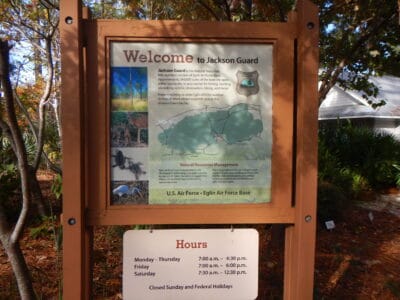
Eglin Air Force Base covers a massive 464,000 acres here in Northwest Florida and we are lucky to have 250,000 of those acres open to the public for recreational use.
To use this land, each person must purchase a Recreational Permit – or Range Pass as it is more commonly called.
Passes are purchased through the Jackson Guard, which is the HQ for Eglin’s Natural Resources Branch.


The land owned by Eglin was once part of the Choctawhatchee National Forest and at that time, forest rangers were known as guards. The station was named after Andrew Jackson and after the forest transferred to the military, Jackson Guard remained as caretaker of the land.
Their office in Niceville offers an amazing look at our native animals, foliage, and history.
Inside the building are animal displays, giving a small glimpse of some of the wildlife found on the reservation.

Coyotes.


We’ve been hearing coyotes a lot up at our camp and have been keeping a close eye on Buddy the Beagle.
Fortunately, we haven’t seen any rattlesnakes this big at camp for many years, but we do have several resident armadillos that live just outside of camp.

We’ve seen some beaver signs along the creek but no actual beavers.

I’m always amazed at how big a feral hog’s skull is.

These pelts are so soft it’s easy to see why they were coveted.

Display cases show artifacts found on the reservation through the years.


The Eglin Reservation is home to the largest contiguous acreage of long leaf pine trees in the world and this tree shows just how old some of these pines are.
This tree was over 500 years old when it was killed by a forest fire in 1989.

One of the main tasks of the early Forest Rangers was fire watch – which could only be done from tall towers.

The original fire towers were wooden, but the Jackson Guard tower was constructed from steel in the late 1920s. It was originally located near Eglin’s West Gate but was moved to its present site in 1941.

There is also a replica of an old lumber mill, which, along with grist mills and turpentine were the area’s early industries.


I’m fascinated with the turpentine industry of this area but it’s hard to find much information. The woods were full of large turpentine camps yet there are very few remains. Bowls, saws, and turpentine tools are found often but these large camps had buildings and cemeteries – of which I can’t find anything about.

I talked to an old historian up in Baker once who told me that “the turpentine industry ’round here was a dirty little secret that no one liked to talk about.”
According to her, the camp conditions were almost intolerable, and the pay was slave wages which indebted the worker to the company store, much like mining towns.
Part of the problem is that a huge portion of the reservation is permanently closed to the public so there is no telling what I would find if I ever got free reign to roam around in there for a while.
It is common to see “cat face” trees which are what trees that have been scarred to let the turpentine run down into the bowls.

The grounds are stunning, and it is always a pleasure to wander around and soak up some of the peacefulness here.


No visit to Jackson Guard would be complete without a visit to the resident deer.


Even if you are not in the market for a Range Pass, stop by Jackson Guard if you’re in Niceville, it’s a wonderful way to soak up some of our natural resources.


